A Story of the Road to the Founding of the Polish Chess Federation
In 2026, the Polish Chess Federation celebrates the centenary of its existence. It is a good moment to look deeper into history, back to the times when Polish lands were divided among three states and chess had to exist without a nationwide patron. For before the Polish Chess Federation was founded in Warsaw on 11 April 1926, almost sixty years of effort, attempts, ideas, and initiatives had passed.
This is a story about people, clubs, dreams, and determination — and about how the Polish chess federation was born.
The 19th Century – Cafés as the Cradle of Polish Chess Life
The story begins in the nineteenth-century cities of the Polish lands, above all Warsaw, Kraków, and Lwów.
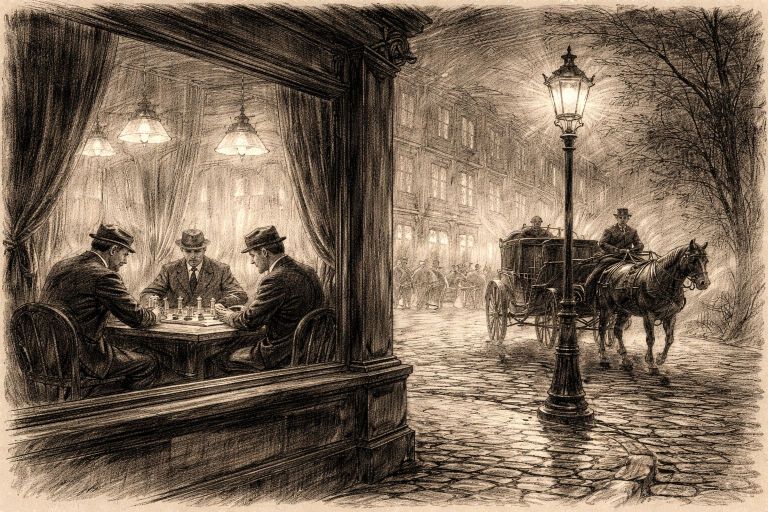
Horse-drawn carriages rumbled through the capital’s streets, gas lamps glowed along Nowy Świat, and in cafés one could increasingly hear the quiet sound of chess pieces. Much like in Paris, Vienna, or Berlin, café tables became the natural meeting places for chess players — spaces for play, conversation, and the exchange of ideas. Before formal clubs were established, it was there that the communities formed from which the Polish chess organization would later emerge.
Within these informal circles, the first generations of masters, writers, and theoreticians matured.
Some of the most outstanding figures of the late 19th century were Johannes Zukertort (world number one in 1878-1886, lost to Steinitz in the first official world championship match in 1886) and Szymon Winawer (world number two in 1878-1880), both belonging to the elite of their time – incidentally, in 1878 they shared first place in the tournament in Paris. This is confirmed by modern retrospective ranking systems such as Chessmetrics. Their position on the international stage was one of the clearest signs that Polish chess had become part of the world chess scene.
Over time, this environment attracted new participants and enthusiasts of the game. In the decades that followed, Polish chess continued to grow in strength.
New masters appeared, and the number of tournaments increased. Yet everything still took place without a permanent structure, without an organization that could say: “We represent Poland.” Political and legal conditions under the partitions made the creation of a federation particularly difficult.
That is why 1893 in Kraków became such an important turning point.
1893 – Kraków Establishes the First Modern Club
In Galicia, under Austrian rule, the Kraków Chess Club was founded.
It was modern and formal, with a genuine statute, elected authorities, and proper documentation. It is the first club whose activity can be traced year by year in archival records — which is why many historians regard it as the oldest “documented” chess club on Polish lands.
Just one year later, in 1894, the Lwów Chess Club was established — the second pillar of the Galician chess community, which would in time become one of the most creative chess environments in Europe.
1899 – Warsaw Returns to the Center: The Founding of WTZGSz
In 1899, the Warsaw chess community reorganized and adopted a formal structure with the creation of the Warsaw Society of Chess Enthusiasts (Warszawskie Towarzystwo Zwolenników Gry Szachowej, WTZGSz).
It was not a formal continuation of earlier, informal gatherings of chess players, but it consciously drew upon the traditions of Warsaw chess life shaped throughout the nineteenth century.
WTZGSz quickly became the strongest chess club in the Kingdom of Poland — and it was within its walls that, three decades later, the Polish Chess Federation would be born.
Yet the road to that moment was still a long one.
The Early 20th Century – The Rubinstein Era and the Maturing Need for a Federation
At the beginning of the twentieth century, Polish chess gained a face that became a symbol of world-class excellence: Akiba Rubinstein. He appears in retrospective Chessmetrics rankings from 1903, and between 1908 and 1914 he reached the position of the world’s strongest chess player.
His successes — together with the growing ambitions of other Polish players and chess centers — made it clear that Polish chess required not only outstanding individuals, but also unified representation and a durable organizational structure capable of operating on the international stage.
1918 – Independence Is Not Enough
After Poland regained independence, it seemed that nothing stood in the way of creating a nationwide chess federation.
In 1920, Adam Żuk-Skarszewski published in Szachista Polski a vision for the establishment of the Polish Chess Federation. He proposed a congress, regional structures, and international representation.
But the country was exhausted by war — and no one was yet able to carry such a major initiative.
1924 – Paris and the Birth of FIDE: A Turning Point
Everything changed in 1924, when a problem emerged during the Olympic chess tournament in Paris:
Poland could not compete as a country because it had no federation.
Moreover, on 20 July 1924, FIDE (Fédération Internationale des Échecs) was founded — and membership was limited exclusively to national chess federations.
This was a moment Polish chess activists remembered well.
It was a clear signal:
➡ “Without a federation, we will not exist in world chess.”
The newspaper Słowo Polskie wrote plainly:
“In Europe, only Poland and Spain do not have a chess federation.”
It sounded like a reproach — but also like a challenge.
1924–1925 – The Country Matures Toward a Federation
Across the country, regional structures began to emerge:
- Poznań Association of Chess Societies (1924),
- Polish Chess Association of the Silesian Voivodeship (1924),
- Polish Chess Problem Association (1925).
By 1925, as many as ten major centers declared readiness to join a nationwide organization: Warsaw, Łódź, Lwów, Kraków, Poznań, Wilno, Białystok, Gdańsk, Pomerania, and Silesia.
Preparations were underway — and the atmosphere was exceptional.
11 April 1926 – The Day Sixty Years of Dreams Came True
It was a Sunday.
In Warsaw, in the elegant hall of the Society of Chess Enthusiasts at 8 Wierzbowa Street, delegates from across the country gathered.
They came from:
- Warsaw,
- Lwów and Kraków,
- Silesia and Poznań,
- Łódź, Wilno, Białystok, and Pomerania.
Altogether, they represented a community of about 1,600 organized chess players throughout Poland.
After nearly sixty years of tournaments, correspondence matches, clubs, and ideas — the moment had arrived.
That day:
- the Polish Chess Federation was founded,
- its statute was adopted,
- the first board was elected, with Józef Żabiński as President and Dawid Przepiórka as Vice-President.
The Federation was tasked with:
- organizing championships,
- uniting clubs,
- training youth,
- representing Poland abroad,
- and ultimately — gaining admission to FIDE.
It was the day when Polish chess became one family.
And the Next Day… The Polish Championships Began
Preparations had already been underway, so a champion was not crowned within a single day — yet it is a fact that on 12 April 1926, the day after the Federation’s founding, the first official Polish Chess Championship, held under the patronage of the new Federation, began.
The tournament lasted nearly three weeks — until 30 April — and its winner was the newly elected Vice-President of the Federation, Dawid Przepiórka.
Symbolic?
Profoundly so.
Epilogue: The Centennial Jubilee — 2026
As we celebrate the centenary of the Polish Chess Federation in 2026, it is worth remembering that this story did not begin in 1926.
Its roots run much deeper:
— in Warsaw cafés of the second half of the nineteenth century,
— in the chess clubs of Kraków and Lwów at the fin de siècle,
— in the ideas of Żuk-Skarszewski,
— in the Paris appeal for a federation,
— and in the determination of dozens of clubs that declared:
“We are creating one Poland — also on the chessboard.”
It was this road — lasting nearly sixty years — that ended on that April day in 1926.
And from that moment on, Polish chess has had a common heart:
The Polish Chess Federation.
Today, the Federation continues to fulfill the tasks largely defined by the 1926 statute — integrating clubs, training youth, and representing Poland on the international stage.
🔖 Bibliography / Main Sources
- A. Filipowicz, Dzieje Polskiego Związku Szachowego do 1956 roku, Warsaw 2007. (on the founding of the Polish Chess Federation) – Tezeusz
- Z kart historii PZSzach. Wczesna historia, PDF document, Polish Chess Federation, available online – PZSzach
- J. Gajewski, Szachy kobiet w Polsce w latach 1945–1989, Rzeszów 2023, Chapter I: Pierwsze kluby szachowe – repozytorium.ur.edu.pl
- Polska Kompozycja Szachowa XIX wieku, Problemista, available online – problemista.eu
- Jeff Sonas, Chessmetrics site (http://www.chessmetrics.com/cm/)
===